


CENTRAL CITY, Pa. — Rain is forecast by lunchtime, so Bonnie Doran, leaning heavily on her cane, packs a pail of flat stones next to the bingo cage in the back of her Subaru.
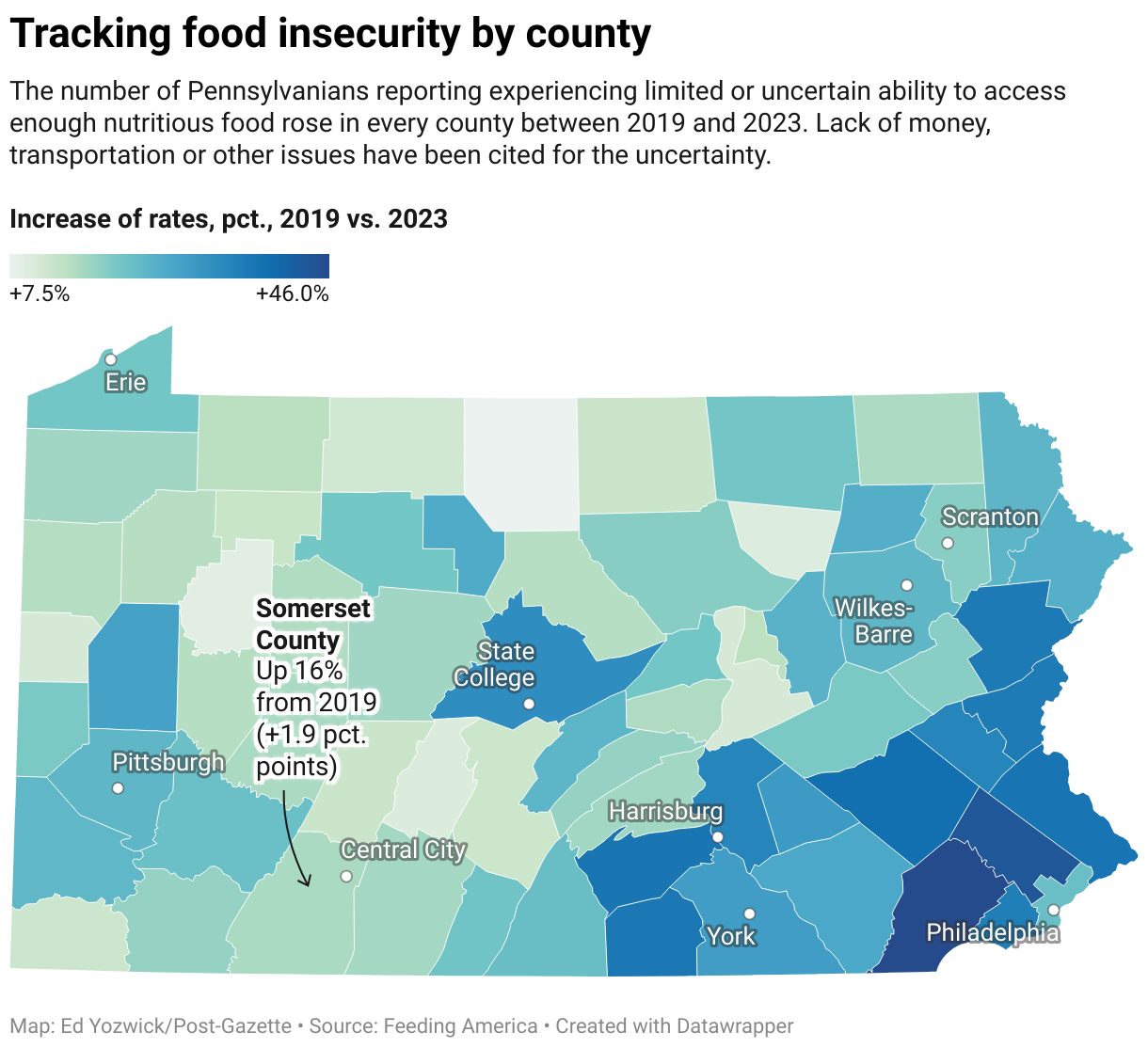
She gathered the stones from her yard and, in case of rain today, the kids can paint rocks with markers or play bingo at the park, says Ms. Doran, a 79-year-old retired nurse. Here in Central City — no stoplights, no supermarkets — is a pocket of rural America, two hours southeast of Pittsburgh in Somerset County, where anxiety about having enough food to eat is rising.

In 2023, the most recent year figures are available, 10,070 people in Somerset County experienced low food security — 13.8% of the county’s population, according to Feeding America, an anti-hunger nonprofit based in Chicago.
That was a 14% increase from 2019.
It’s not just Somerset feeling rising anxiety about accessing nutritious food. More populated areas are also seeing a rise in food insecurity, while an 11.4% spike in grocery prices in 2022 — the biggest jump since Jimmy Carter was in the White House — revealed the pernicious effects of inflation on household budgets.
The price of food prepared and eaten at home shot up 25% between 2019 and 2023, well above the historical average annual increase of 2% to 3%, according to the U.S. Department of Agriculture.
In 2023, the Greater Pittsburgh Community Food Bank provided 788,000 summer meals to needy children in Allegheny County; a year later, the number of meals exceeded 1 million — a 27% increase and a record since the food bank started in 1980.
The food bank works across Western Pennsylvania and every week its delivery vehicles trek across the region’s highways and winding two-lane roads to get meals to some of the more hidden places where there’s hunger.
Counting all of the food bank’s programs, 53 million meals were provided in its 11-county service area in fiscal 2025, another record and up from 42 million meals provided in 2023 — a 26% increase.
And at places like the park in Central City, volunteers reliably show up to help and those in need seek out the help that they hope won’t be necessary for much longer.
About two dozen youngsters, with parents and grandparents, drifted into Central City Community Park for the kids’ lunch on a hot mid-summer Tuesday.
In the park pavilion, behind a narrow block museum building filled with artifacts of the town’s coal mining past, Ms. Doran and a few helpers prepared a lunch she says is a hit with kids, Walking Tacos: a scoop of ground meat, shredded cheddar cheese and lettuce and chopped tomatoes, all served in a palm-size bag of crushed Doritos.
A squirt of sour cream, which Ms. Doran brought from home, is optional.
“You open the bag and smash,” Ms. Doran reminds a handful of volunteers who are getting things ready. “Remember the routine.”
Hunger is a subjective feeling caused by not having enough food to eat. It can be hard to measure.
In 2006, the USDA struck the word “hunger” from its annual survey and divided food security into food secure, low food security and very low food security.
Low food security reflects a person’s reduced access to nutritional food, due to poverty, transportation, disability or other issues.
People with very low food security report eating less, having to skip meals or experiencing unplanned weight loss because of difficulties getting enough food.
Respondents to the USDA’s survey are slotted into one group or the other based on answers they give. Since the 1990s, tens of thousands of households have been surveyed every year by the federal department about access to food.
While food insecurity is not hunger, it can be the first sign of impending hunger.
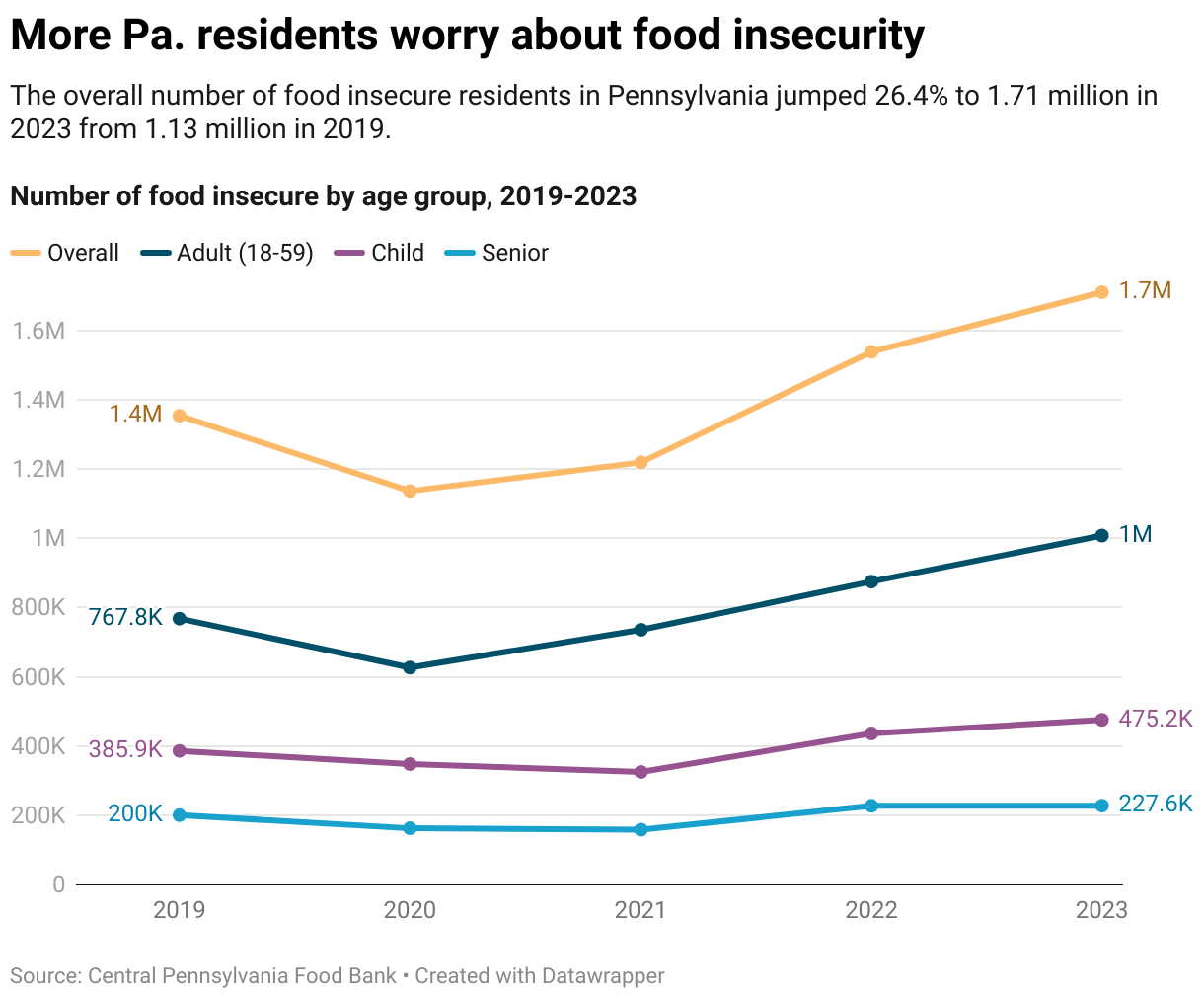
In Pennsylvania, food insecurity rose 26% to 1.71 million people from 1.35 million people between 2019 and 2023, despite the start of free school breakfasts for all elementary and secondary school students three years ago, courtesy of the General Assembly.
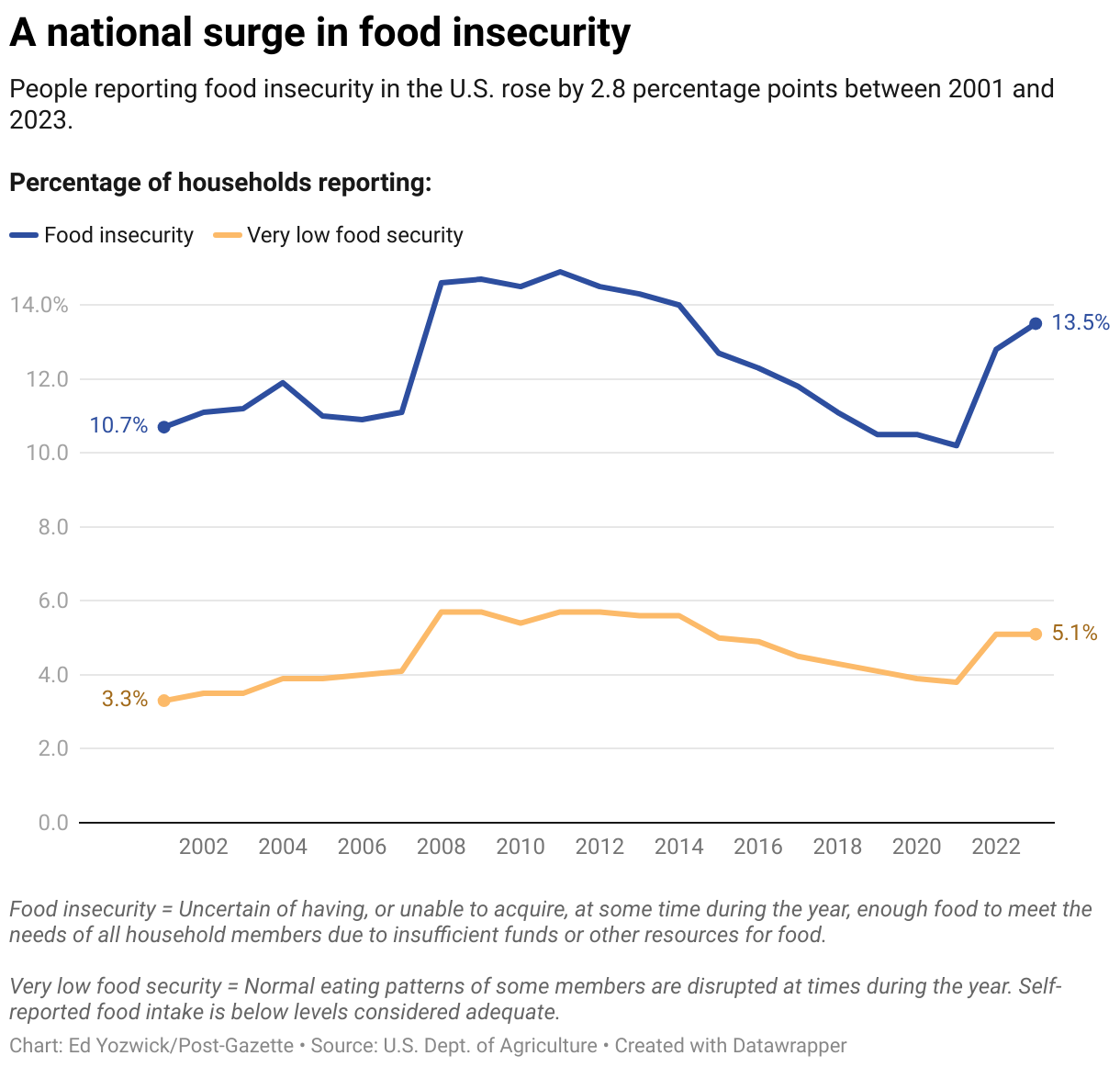
The increases in food insecurity nationwide during the same five years outpaced those in Somerset and Pennsylvania.
The number of households reporting very low food security, where meals were skipped or smaller portions served, jumped 58% to 6.8 million in 2023 from 4.3 million in 2019, according to the USDA, while households with low food security rose 20.4% to 11.2 million during the same period.
Lower-income households also felt the sting of inflation even more than others because of the jump in the costs of hospital care, health insurance, prescription drugs and other medical expenses between 1984 and 2022, according to a new study by the nonpartisan Congressional Budget Office.
During that period, the Washington, D.C.-based nonprofit Data Foundation found that the cost of health services more than quintupled, despite easing in recent years.

The COVID-19 pandemic and the emergency allocation of food stamps starting in 2020 helped flatten the demand curve for food bank meals, with a total 42 million meals delivered by the Greater Pittsburgh Community Food Bank in both 2022 and 2023. But the emergency food stamp program ended in March 2023.
The result: Demand for meals from the Pittsburgh food bank rose 14.2% in 2024 to 48 million meals and another 10.4% in 2025 to 53 million meals — an all-time record.
“A lot of pandemic-era supports ended and that really drove an increase in food insecurity,” says Crystal FitzSimons, president of the nonprofit Food Research & Action Center, a nonprofit nutrition advocacy group in Washington, D.C.
Shifting priorities in Washington, D.C., where leadership is focused on cutting costs and cracking down on potential fraud, are slated to reduce federal spending still further.


Recently approved budget bills will cut funding for food stamps by 7% or $9 billion in fiscal 2026, which starts Oct. 1. A food program for pregnant women, infants and children will be pared by $300 million.
The Trump administration canceled a $13 million farm-to-food bank program in Pennsylvania that provided fresh produce from 189 farms to 14 food banks for distribution to needy families. Gov. Josh Shapiro has filed an administrative appeal.
Donations to the Pittsburgh Food Bank have been steady through the pandemic years, but the uptick in demand starting in 2024 is forcing the nonprofit to tap its emergency savings.
“Generosity from the community is the reason we were able to meet the highest need we’ve ever seen in history,” spokeswoman Christa Johnson said in a prepared statement. “With changes to SNAP and Medicaid, we’re anticipating an increase in need while simultaneously feeling the impact of government funding cuts as well.”

For those looking, the signs of rising food insecurity in rural Pennsylvania abound.
In Confluence Borough, a 40-minute drive southwest of Central City, to-go bags of kids’ breakfasts of Pop Tarts, banana and an 8-ounce white milk were being handed out to needy families in June. Lunch was two beef sticks, rolls, a cucumber, an orange and half pint of chocolate milk.
In all, 125 people had signed up for the meals at the Confluence Community Center — 65 more than a year ago, organizers say, reflecting rising need.

Conemaugh Valley School District in nearby Johnstown doubled the number of weekly meals it served to youngsters over the summer to 9,500 — only the program’s second year of operation — food service Director Jenna Russell says.
Last year, the 700-student school district in Cambria County, where every student is income-qualified for free daily breakfasts and lunches during the school year, began its summer program by serving 4,750 meals per week, which means the program doubled when it opened its second year in June.
Conemaugh schools Superintendent Shane Hazenstab says the program provides a stable source of food for needy kids when school is out.
“When you’re talking about basic needs of a human being, it serves that basic need that all other things are built upon,” he said.
Part of the increase in demand for the school program was attributed to a switch to bagged, grab-and-go lunches, which simplifies meal pickup, says Chelsey Novak, child nutrition manager at Greater Pittsburgh Community Food Bank.
But organizers say such changes don’t discount the increasing difficulties that families in their areas are having making ends meet.

Ms. Doran, who says she never imagined herself being anything else in life but a nurse, weaves her car along twisting gravel roads and fields of golden corn tassels to sprawling Camp Harmony in Hooversville, a town of churches, abandoned houses and rusting rail overpass.
The camp has a commercial kitchen, where hot lunches are prepared for distribution throughout Somerset County for the summer program.
Last summer, 15 volunteers like Ms. Doran shuttled 21,000 meals to 25 locations in the county. The cost per meal to the sponsoring agency — about $3.33.
Ms. Doran has seen a lot of things change during her life. The 1964 Mt. Lebanon High School graduate went through school at a time when girls were not allowed to run the full distance of a basketball court in gym class, out of a concern for their safety.
“It was too strenuous for us girls,” she says, still indignant.


Ms. Doran, who was among the first graduating classes of advanced practice nurses at the University of Pittsburgh, helped start an HIV clinic at Allegheny General Hospital with fellow advanced practice nurse Stuart Fisk.
Mr. Fisk, 65, remembers her being drawn to people who were often sidelined by the medical establishment.
“Her grit, her ferocity,” he says. “She’s feisty when advocating for a group of people. She stood her ground.”
Ms. Doran retired from AGH in 2008 and moved permanently from Mt. Lebanon to the family’s onetime fishing camp just outside Central City with husband, Terry, 78, a retired high school principal.
Several years after moving to Somerset, Ms. Doran got involved in the local food bank after learning they weren’t going to be able to distribute meat with Christmas meal baskets because of budgetary constraints. She bought enough pork to make sure every person would have a complete holiday meal.

Hunger may not always be easy to recognize, but 63-year-old Gary Ohler says he has seen it.
Mr. Ohler, who does landscaping for a physician to supplement his Social Security checks, is the emergency contact for a food bank in the coal patch town of Cairnbrook, Somerset County, that is operated by the nonprofit Central City-Shade Ministerium Inc.
Between 60 and 70 families show up once a month for green beans, corn, canned mixed vegetables, oranges, carrots, “just regular stuff like that,” Mr. Ohler says.
“We don’t turn anybody away because people are hurting so bad,” Mr. Ohler says. “A lot of children are hungry. No matter where you go, children are hungry. Parents don’t have very good jobs.”
One night, a family of seven, including five children, sought emergency help from the food pantry after the father lost his job mining coal, he says.
“Sometimes you see that a lot, hungry kids,” says Mr. Ohler, a former dairy farmer who has called the borough home for nearly 35 years. “Sometimes you see children, kids that come to the food pantry, eating fruit right out of the box because they’re hungry.
“There’s people here — not a lot — they have to take a choice to pay the bills or cut the food back. A lot of them got laid off, coal miners. I have seen that already.”
Back at the park pavilion, Ms. Doran opens a plastic, red-check table cloth on a picnic table and pulls on a baseball cap backward. Nearby church bells toll the noon hour.
Money for the games and toys comes from Ms. Doran’s solicitations to the few remaining businesses in town — the Polish Club, Central City VFW Post 7457, a funeral home.
“C’mon kids, line up! Time to eat! I left my whistle in the car. We need kids! We need help! Wait, wait, wait: let me get my cane. Oh, good save there, Kelly!”
“Do you want to paint rocks,” she says. “Hands up to paint rocks. Do you want to paint rocks or play bingo? Bingo it is!”
“O-74,” the caller cries a few minutes later, as some kids paint rocks instead.
“O-74,” a chorus of children murmur, sitting at picnic tables, hunched over their cards.

Phyllis Robb, 74, is visiting the Summer Youth Cafe in Central City for the first time. With her is 14-year-old granddaughter, Ally, who has special needs.
Ally’s 39-year-old dad and 45-year-old stay-at-home mom live in a trailer behind Ms. Robb’s brick home nearby. He drives for the restaurant meal delivery service DoorDash, Ms. Robb says. Business has not been good.
“Right now, it’s bad on DoorDash,” she says. “People don’t order like they used to,” with escalating meal prices.
“I don’t know how people do it who have to buy food all the time,” she says.
Ms. Robb says she worked at a pizza shop in town for six years before it closed. The owner then began driving for DoorDash, too, she says.
Ally suddenly bolts from Ms. Robb’s side to paint rocks as bingo continues.
“B-7!”
“O-63!”
“Bingo!”
Tiffany Jimmo, 31, and her four children, all ages 12 or under, are regulars at the summer noon meals in the park. She is a stay-at-home mom and husband Shane, 34, works preparing coal samples for lab analysis. Money is tight, she says, and it’s easier to make ends meet in the fall when the kids start classes.
“They’re eating breakfast and lunch at school then, but in summer, meal costs rise,” she says. “Before, it was really easy — it was never really easy — but as food prices have risen, it’s harder,” she says, rocking 8-month-old son Harvey on her hip.
“There will be enough for seconds if any of you kids want seconds,” Ms. Doran shouts above the excited din of children playing.

By 12:30, after the red-check tablecloth has been neatly folded back up, three kids on bicycles coast up to the pavilion, asking to eat.
Distressed, Ms. Doran tells them there’s nothing left, to come earlier next time if they can.
“I feel bad we couldn’t feed those kids,” she says after they slowly pedaled off. “I’ll order more meals tomorrow.”
The bingo cage is packed away in her car along with the pail of remaining stones and then Ms. Doran is weaving through the looping streets of Central City for home, over heavily wooded Bald Mountain Knob, lush with white rhododendron blossoms.
She has an afternoon physical therapy session to speed healing of a recent knee replacement operation.
“People in Washington have no idea how people in this place live,” says Ms. Doran, the hard-boiled nurse veneer melting.
“Just look at our kids, look at how heavy they are.”
Then in a low voice, she adds, “This is America. It’s just so sad.”
Kris B. Mamula, kmamula@post-gazette.com, @kmamula1
Advertisement
Advertisement